1 · Who is installing?
Check MCS status for the technology in your quote. Confirm which legal business will contract with you and do the work.

Home energy finance · Consumer protection
The Warm Homes Loan Scheme opens another route to solar and batteries. Requiring an MCS-certified installer is a welcome quality gate. But a registration check is one layer of protection—not a guarantee that every sales claim, deposit or future problem is covered.
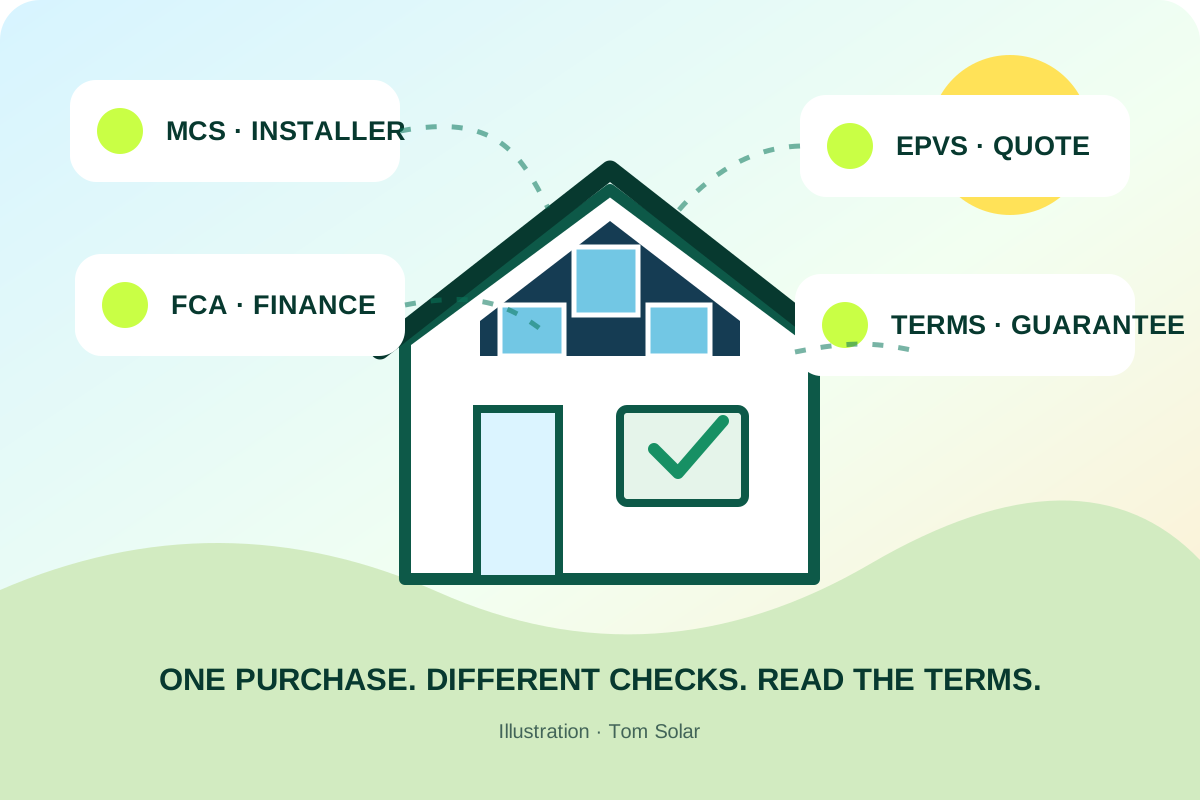
Warm Homes scheme rules require eligible solar and battery work to be installed by an MCS-certified installer. An EPVS check can add a separate review of sales documents and estimates. FCA checks concern the finance business and its permissions. These checks are valuable, but they do not promise a particular bill saving or remove every risk.
The government published the Warm Homes Loan Scheme’s customer-facing details on 27 October 2026. For eligible solar PV and battery installations, the rules require MCS-certified products and installers, with lenders expected to verify installer status through MCS data. That gives the finance journey a real installation-quality check, not simply a credit decision.
But MCS, EPVS and the Financial Conduct Authority have different jobs. A sound process checks the installation, the figures in the quote, the finance agreement and the timing of payments.
Eligible installations must use MCS-certified products and an installer certified for the technology being installed. Lenders are expected to verify the installer’s status. MCS provides a recognised framework for competence, product and installation standards, and routes for complaints and remediation.
That is a meaningful safeguard: customers and lenders can check whether the installer is certified for the proposed work. But homeowners should still ask for the exact legal business name and certification details, then collect the MCS certificate at handover.
EPVS focuses on the customer proposition and the figures used to explain a system. Its membership criteria include relevant qualifications, MCS or Flexi-Orb certification, insurance, good business standing and membership of a CTSI-approved consumer code. It also validates sales documents and performance estimates against approved methods.
That can help expose an estimate based on unrealistic electricity use or savings assumptions. But a forecast remains an estimate, not a guaranteed bill reduction. Actual results depend on the household, system design, tariffs, weather and how electricity is used.
The published Warm Homes Scheme Rules name MCS verification; they do not name EPVS as a universal scheme requirement. If a particular finance portal also checks EPVS registration, that is an additional condition of that finance route. It is a useful extra screen, but should not be described as a requirement that automatically applies to every lender.
The FCA deals with financial services: for example, whether a lender or a business arranging finance has the appropriate authorisation or status for its activities. Its Firm Checker helps customers confirm a firm’s permissions. FCA status does not certify solar workmanship or validate the energy-saving forecast.
The FCA’s May 2026 review found some firms approving financial promotions with unsubstantiated claims. That review covered other financial sectors, not solar specifically. Still, it is a timely reminder to demand clear, supported claims and to compare the APR, fees, term and total amount repayable before agreeing finance.
Check MCS status for the technology in your quote. Confirm which legal business will contract with you and do the work.
If your quote is EPVS-validated, ask to see the certificate and the usage, tariff and savings assumptions.
Get the amount, due date, refund terms and named protection policy in writing. Ask whether it covers advance payments, unfinished work or only workmanship.
Ask the lender and installer to set out payment milestones and what evidence is needed before final payment.
Check permissions, APR, fees, term, monthly instalment and total repayment. Lower bills and lower monthly outgoings are not the same thing.
Find the complaints route, code membership, insurance-backed guarantee terms and who to contact if the installer stops trading.
For a full homeowner checklist covering MCS, EPVS, finance, deposits, guarantees and complaints, read our solar consumer protection guide.
Requiring installer certification before finance proceeds is the right kind of quality check. Independent validation can add scrutiny to the sales figures. Both raise the bar for a business using that finance route.
Still, a registration check cannot establish whether a particular sales conversation was fair, whether a deposit is covered by the policy the customer needs, or whether a company will still be trading years later. Ask not only “Are they registered?” but “What exactly does that registration cover, and what paperwork proves the protection I’m relying on?”
See the scheme limits, participating lenders, eligibility and how to compare the loan with your installation quote.
Warm Homes Loan Scheme: the full solar and battery guide →