Separate inverters can feed generation into different points in a home installation. Their combined behaviour matters, even when each device is within its own output rating.
Plug-in solar · Electrical safetyPlug-in solar is legal.
Plug-in solar is legal.
Doubling up?
Different story.
The savings from one small kit can look modest, so it is easy to see why someone might buy another—and perhaps a third. But a second plug-in system is not simply “more of the same”. It changes the electrical setup, and it is outside the current one-device connection rule.
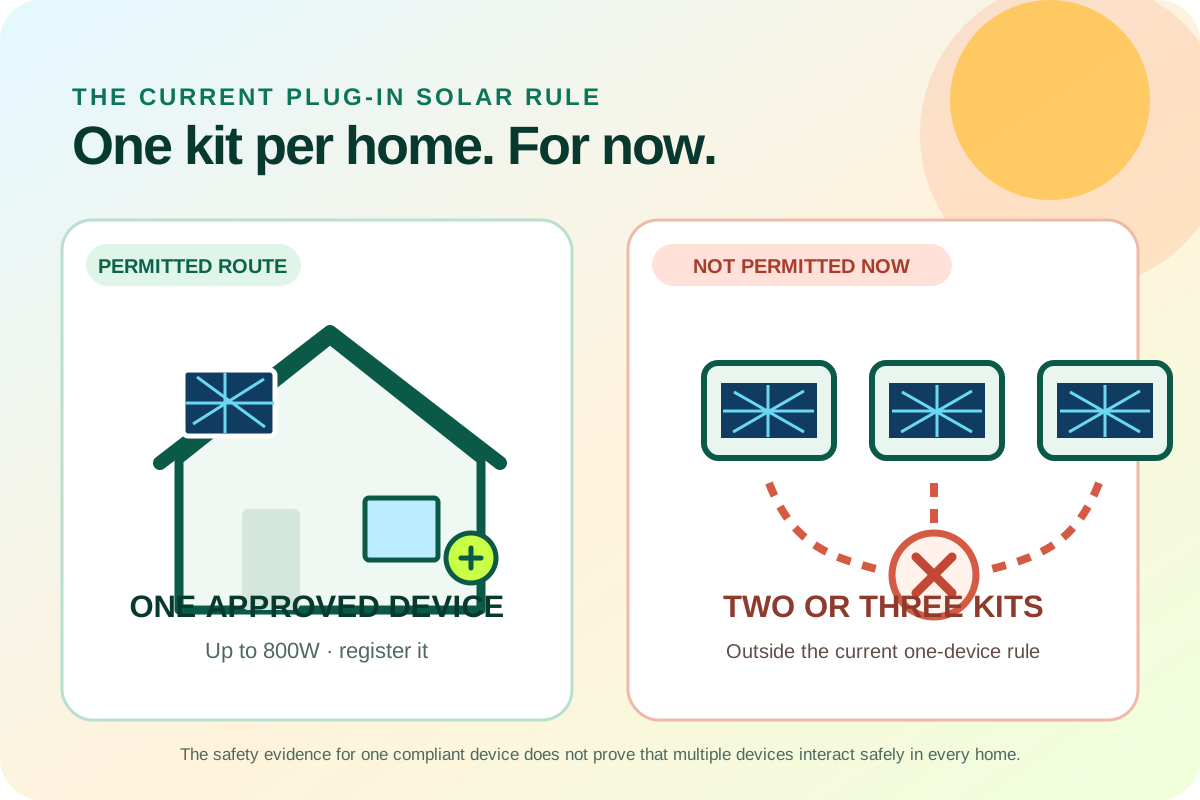
The short version: one device per home under today’s connection rule
Plug-in solar is now a legal product route in Great Britain when the equipment meets the Government’s interim product specification. Separately, the current Energy Networks Association connection standard, EREC G98, permits a single plug-in micro-generator in a customer installation, up to 800W registered capacity. Its current text says connecting more than one plug-in micro-generator is not allowed.
So the headline is not “plug-in solar is dangerous”. The accurate message is: one compliant device, used as intended, has been tested under defined conditions; adding extra devices creates a setup the current rule does not permit and the published government tests did not assess as a combination.
Important distinction: product approval answers whether a particular device meets its product requirements. It does not certify the condition or wiring layout of every home where someone may plug it in.
Why might people double up?
The logic is understandable. An 800W kit can trim daytime imports, but it cannot run a whole home or replace a professionally designed roof system. If the first kit makes a visible but limited difference to the bill, buying a second can seem like an easy next step—especially if another panel bundle appears online at a tempting price.
That is exactly where the “it’s only a plug” assumption becomes unhelpful. Household circuits, protective devices and existing generation were not designed on the assumption that owners would keep adding separate generators until the savings looked worthwhile.
More panels inside a single compliant kit are not automatically the same as more separate plug-in systems. The important parts are the approved device configuration, its inverter output and the installation rules. Don’t split, combine or modify kits to try to create a larger system.
Where the risk question comes from
Electricity normally travels from the supply through the home’s circuits to appliances. A plug-in generator adds another source of electricity into those circuits. That can change current paths and the assumptions behind how an installation is protected.
That does not mean every plug-in solar unit overloads a circuit, or that a second kit will inevitably cause a fire. It means suitability depends on the approved device, wiring condition, circuit layout and protective devices—and the evidence for one device should not be stretched to cover several devices working together.
The IET has raised questions about whether multiple units could affect protective-device behaviour, including RCD response and disconnection under faults or loss of mains.
Older wiring, altered circuits, socket condition and existing rooftop generation can change the picture. A device’s product test is not an inspection of a house.
The government’s June 2026 safety study tested representative plug-in PV devices against UK domestic circuit conditions and fault scenarios. It concluded devices could operate safely within the tested conditions, with effective protective-device operation and no unacceptable thermal effects. The IET’s July statement welcomed stronger product requirements but pointed out that the commissioned tests assessed individual units and did not test how several units would behave together in normal, fault or loss-of-mains conditions.
Those statements fit together: the government study is reassuring about compliant products in the tested configurations; the IET identifies an evidence gap around multiple devices and the diverse wiring found in real homes.
What the current rule says—and what it does not say
EREC G98 Issue 2 Amendment 1, published by the Energy Networks Association in August 2026, sets the current Great Britain connection requirements. It permits one plug-in micro-generator per customer installation, up to 800W registered capacity, and says more than one is not allowed. The rule is per installation, not per socket or per person.
During policy development there was discussion about whether a future route might allow a device on each separate final circuit. That should not be confused with the current rule. As of 1 November 2026, the published G98 text still says one device per customer installation.
If the home already has permanently wired generation, G98 also sets an aggregate capacity condition. A plug-in kit should not be treated as automatically separate from a rooftop PV system or other micro-generator. Ask the existing installer or DNO before adding one.
The product legislation separately requires plug-in micro-generators to meet the Government’s interim product specification. It limits the product route to solar generation with maximum rated AC output not exceeding 800W; it does not make every online kit compliant, and it does not include plug-in battery storage.
A simple owner checklist
- Choose a compliant model. Check the make and model against the ENA register and buy from a reputable seller.
- Use one system only. Do not connect a second or third separate micro-generator, even on another circuit, unless the connection rules are formally changed.
- Register it. Use the official UK Plug-in Solar Registration service and follow the manufacturer’s instructions.
- Check the home. If wiring is old or uncertain, the socket is damaged, protective devices trip repeatedly, or you already have solar, battery or other generation, seek competent advice first.
- Do not improvise. Avoid extension leads, multi-way adaptors, altered plugs, cables or inverters, and do not open or rewire equipment yourself.
Already plugged in more than one? Stop using the additional device and arrange safe disconnection with the retailer, manufacturer or a competent electrician. Do not dismantle plugs or fixed wiring yourself. If you notice unusual heat, a burning smell, scorch marks, buzzing or repeated tripping, stop using the equipment and get competent electrical help promptly.
What this means for buyers and sellers
Retailers and manufacturers need to make the limit hard to miss. The law and the product packaging should not leave customers to infer that two individually compliant kits make a compliant combined setup. A device register and a DNO notification help with network visibility, but registration is not a physical inspection of a home’s wiring.
For homeowners, the useful question is not “Can I buy another panel?” It is “Does the current standard permit another plug-in generator at my property, and has the actual installation been assessed?” Today, the answer to the first question is no for a second plug-in micro-generator under G98.
There is a constructive path forward: keep collecting real-world evidence, make the consumer limit clear at point of sale, and only revise connection rules when multiple-device behaviour has been tested and the product, wiring and registration safeguards support it.
Could plug-in solar affect Warmer Homes Scotland support?
Home Energy Scotland’s published Warmer Homes Scotland criteria focus on the household and the property. I cannot find a published rule saying that an existing plug-in solar panel automatically makes a household ineligible. The scheme’s assessor recommends improvements for the home, so existing generation could affect whether additional solar is suitable or funded; that is different from losing access to other recommended measures such as insulation or heating.
There is an important timing caveat: Home Energy Scotland says eligibility may be affected if you carry out home improvements after speaking to an adviser but before Warmworks assesses the property. If you are applying, disclose any plug-in kit and ask how it will be treated before installing or changing anything. The published guidance does not specifically explain whether a plug-in panel counts as “existing solar” for every assessment.
Also keep the schemes separate: standard solar PV and battery funding was withdrawn from the Home Energy Scotland Grant and Loan in June 2024. That is a limit on funding those measures under that scheme, not a stated blanket exclusion from Warmer Homes Scotland.
Warmer Homes Scotland eligibility and assessment · Home Energy Scotland Grant and Loan terms · Tom Solar’s Scottish solar funding guide
Read the full guide
Our updated guide explains the plug-in route, the one-device rule, the wiring concerns and the practical checks for Scottish homeowners.
Open the plug-in solar safety guide →Sources and further reading
- Energy Networks Association: EREC G98 Issue 2 Amendment 1 — current connection rule and single-device limit.
- DESNZ: Plug-in solar electrical safety study — findings for representative products under tested conditions.
- IET: updated safety statement, 30 July 2026 — concerns about multiple devices and existing wiring.
- The 2026 Plugs and Sockets and ESQCR amendment regulations — product compliance requirements.
Checked 1 November 2026. This article explains the published rules and safety evidence; it is not an electrical inspection. Check the current ENA register and connection requirements before installing a device.