
Solar panels · walls and facades · Scotland
Wall-mounted solar panels in Scotland: do they work, and are they worth it?
A wall can generate useful solar electricity, but vertical panels are a specialist option—not an automatic substitute for a suitable roof. The wall’s direction, shade, structure, planning status and installation cost all matter.
Start with the real question
Can solar panels be mounted vertically on a house wall?
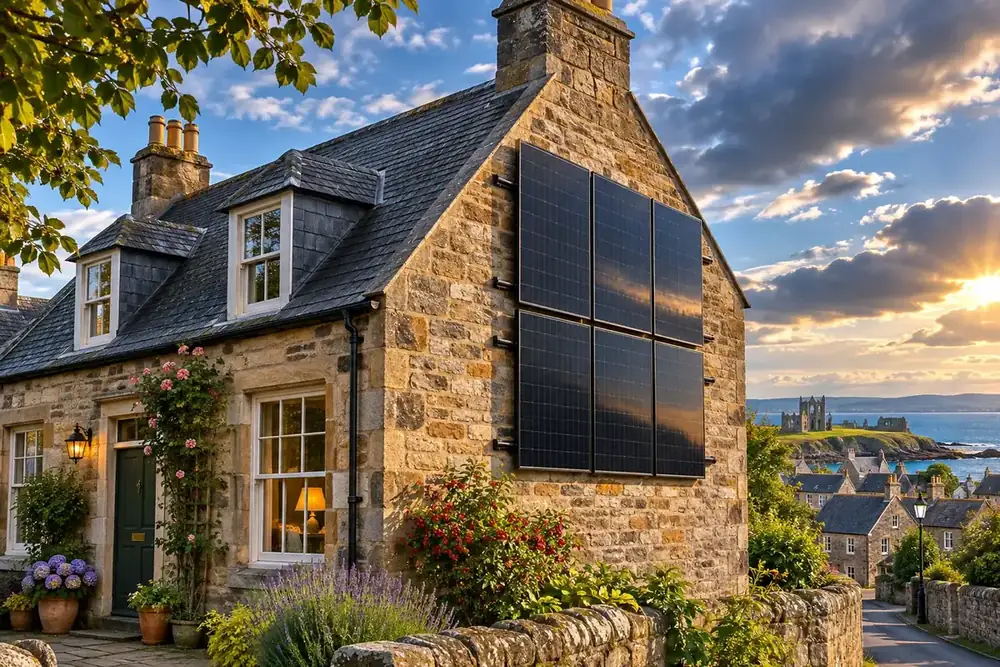
Yes. Photovoltaic panels can be installed on a properly assessed wall using a mounting system and fixings designed for that surface. The technical question is whether the proposed wall can support the system safely, receives enough useful sunlight, and produces electricity at a cost that makes sense for the household.
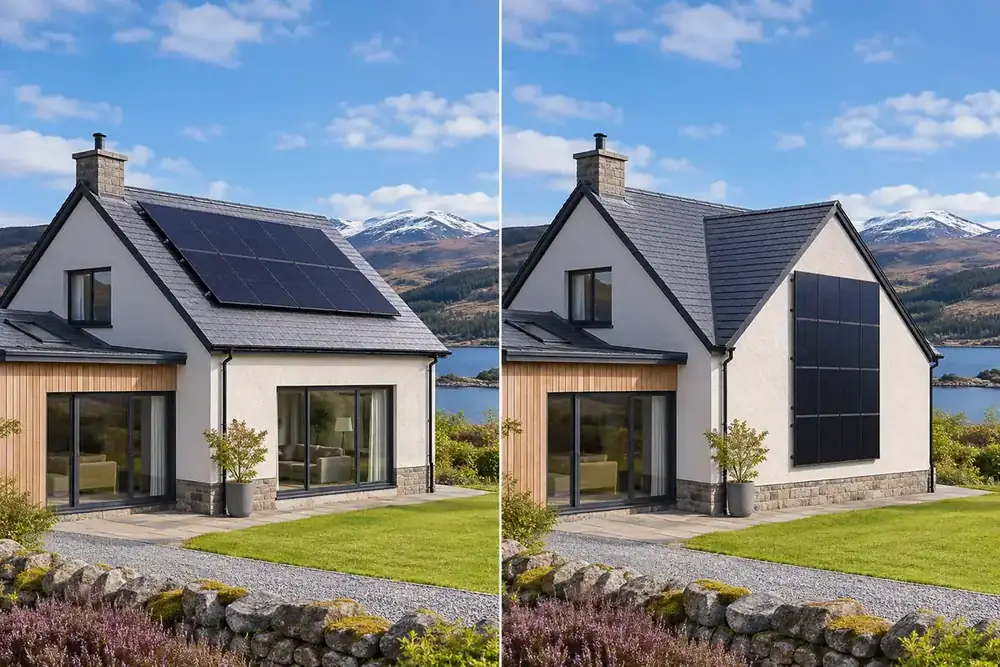
Wall-mounted solar is most worth investigating when a roof has little usable space, faces an unhelpful direction, is heavily shaded, or cannot be altered. A clear, sun-facing gable may provide another option. If the roof is already suitable, it will often accommodate more panels and produce more annual electricity for the money.
A 450 W panel rating describes its laboratory output under standard test conditions. It does not tell you how many kilowatt-hours that panel will make on a particular Scottish wall over a year.
Generation and performance
How much electricity will wall-mounted solar produce?
There is no honest Scotland-wide output figure for a wall-mounted panel. Two walls in the same town can perform very differently because one faces south with an open horizon while the other faces north or is shaded by trees, neighbouring buildings, chimneys or a hill.
Vertical panels receive sunlight at a different angle from conventionally tilted roof panels. A south-facing wall can still generate electricity, and the low winter sun can meet a vertical surface more directly. But the UK’s strongest solar resource arrives during brighter, longer summer days, when a steeply tilted wall is usually less favourably aligned than a well-oriented roof array. Do not turn that seasonal point into a promise of strong winter output.
Use the European Commission’s PVGIS calculator as a useful first comparison. It lets you set the location, panel direction and slope, and gives monthly as well as annual estimates. Ask your installer to model the actual wall, nearby shading and system losses—not a standard roof setting copied from another quote.
An annual total can hide the summer/winter pattern. Check the assumptions and compare the wall option with any usable roof area on the same basis.
Scottish daylight
Do vertical solar panels work better in winter?
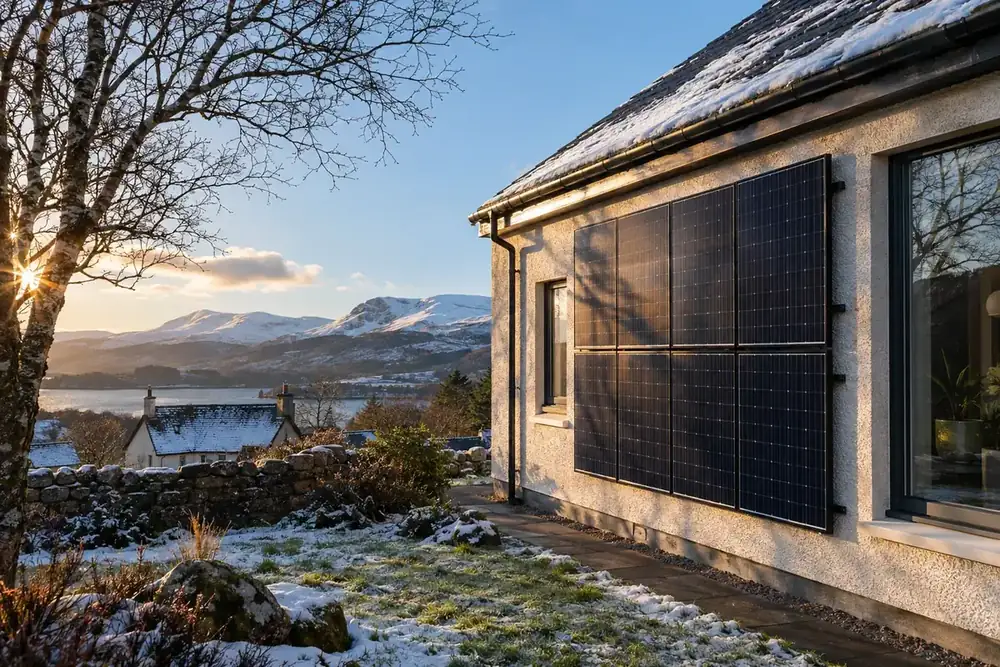
They can have an angle advantage in some winter conditions: the sun stays lower in the sky, so its rays can strike a vertical south-facing surface more directly than a shallow roof. Snow is also less likely to sit on a vertical module. Neither point changes the basic fact that Scotland has shorter daylight hours and weaker solar resource in winter.
So a wall array may contribute at a useful time of year, but it should not be sold as a way to eliminate winter imports or guarantee a home’s winter demand. The result depends on the exact location, orientation, shade and system size. A monthly generation estimate is the only sensible starting point.
Think about when the home uses electricity as well as how much the panels make. A smaller wall array may be useful if its daytime output is consumed directly, but exporting surplus or adding a battery changes the financial calculation. Storage should be assessed against the household’s actual use and tariff.
Direction and shade
Which direction should the wall face?
A clear south-facing wall is generally the first one to assess for annual generation in Scotland. South-east and south-west walls can also work. East-facing walls favour morning sunlight; west-facing walls favour later afternoon sunlight. A north-facing wall is usually a difficult economic case and should not be treated as viable without a convincing, location-specific model.
Direction is only part of the picture. A chimney, porch, drainpipe, adjacent roof, tree or neighbouring building may cast a long shadow across a vertical array. The installer should assess shading over the day and through the year, including whether panel-level electronics are actually justified by the proposed layout.
| Wall or site feature | What to check |
|---|---|
| South-facing and open | Often the strongest wall candidate; model the actual vertical angle and compare it with the roof. |
| East or west-facing | Generation shifts toward morning or afternoon. Match the profile to household use and export assumptions. |
| North-facing | Usually weak for direct sunlight in Scotland. Do not proceed on marketing claims alone; demand a credible model. |
| Partly shaded | Identify what casts the shadow, when it falls, and what the system design does about it. |
The building matters
Can any wall take solar panels?
No. The installer needs to assess the wall construction and condition, the proposed anchors, panel and frame loads, wind exposure, weatherproofing and how the cables will enter the building. Older stonework, render, cavity walls and timber-framed or clad walls need the right fixings and competent assessment; a generic bracket is not proof that a particular wall is suitable.
Access can be more involved than a roof installation. The quote may need specialist brackets, scaffold or a lifting platform, and the wall may only fit a small number of modules. Those costs can make the cost per unit of expected generation higher even if the panel hardware itself is familiar.
- Is the masonry or wall system sound and suitable for the specified fixings?
- Has the design accounted for wind loading and exposure at this exact site?
- Where will cables run, and how will wall penetrations be sealed?
- Can the panels be accessed safely for inspection or repair?
- Does the estimate include access equipment, mounting hardware and electrical work?
- Has the installer checked shading, orientation and the actual usable area?
Planning rules in Scotland
Do wall-mounted solar panels need planning permission?
For solar equipment fitted to a dwelling, Scotland’s householder permitted development rules are set out in Class 6HA of Circular 1/2024. Wall-mounted panels can fall within permitted development if every relevant condition is met. The Scottish rule allows the equipment to project no more than 1 metre from the outer surface of the wall.
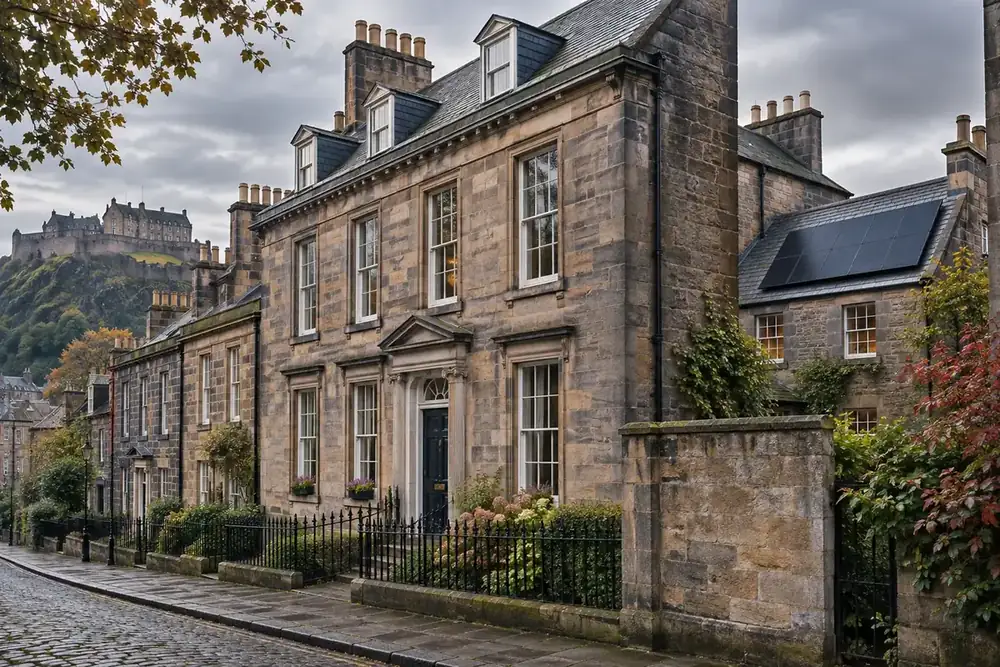
There are important exclusions. Class 6HA permitted development does not apply to a listed building or a property within the curtilage of a listed building, or to a property within a World Heritage Site. In a conservation area, the panels cannot be on the principal elevation or on a side elevation that fronts a road. If those limits rule out permitted development, that does not automatically mean panels are prohibited; it means you should ask the planning authority whether an application or another consent is needed before proceeding.
Solar panels on an outbuilding are covered by a separate class, with different limits, including a 500 mm projection limit and a restriction on buildings in the front curtilage. Do not apply the dwelling rule to a garage or other outbuilding without checking which class applies.
Planning permission is only one part of the check. Listed building consent may be required for changes that affect a listed property’s character. Ask the local planning authority about the exact elevation and property designation, and ask the building standards team whether a building warrant is required for the proposed work. For a flat or tenement, also resolve ownership, title and shared-wall consent before paying for a design.
Before accepting a quote
How to tell whether wall-mounted solar is worth it
Ask for the wall array to be assessed as its own design. The estimate should show expected generation by month, the assumed panel direction and slope, shade and system losses, how much electricity the household may use directly, and what is expected to be exported. Then compare the full installed cost with the useful electricity—not just the panel count or headline kilowatt-peak rating.
- Ask for the wall direction and tilt used in the model.
- Ask how shading was assessed and what losses were included.
- Compare wall, roof and any other feasible layout on the same assumptions.
- Check the full installed price, including mounting, access and electrical work.
- Ask what planning, heritage, building standards and DNO steps apply to your property.
- Keep the option to do nothing if the numbers or permissions do not stack up.
A vertical array can be a good answer to a specific site problem. It is not automatically a good investment simply because a wall is empty.
Common questions
Wall-mounted solar FAQs
Are wall-mounted solar panels allowed in Scotland?
They can fall within permitted development rights under Class 6HA when fitted to a dwelling and all conditions are met. The 1 metre projection limit, listed-building and World Heritage exclusions, and conservation-area elevation rules matter. Confirm the position for the exact property with the planning authority.
Do wall-mounted solar panels work in winter?
Yes, they generate in winter daylight, but shorter days and lower sunlight mean winter output is usually much lower than summer. A vertical south-facing array can make better use of low-angle sun in some conditions, but that does not guarantee high winter production.
How much electricity will a wall-mounted solar array generate?
There is no reliable single figure. Output depends on location, wall direction, vertical tilt, shading, panel capacity, system losses and design. Ask for a location-specific monthly estimate using the wall’s actual orientation.
Are wall-mounted solar panels more expensive than roof panels?
They can be. Wall brackets, access equipment, structural checks, cable routes and a smaller array can increase the installed cost per unit of annual generation. Compare the complete design and generation estimate rather than the panel price alone.
Can I put solar panels on a wall in a Scottish conservation area?
Under Class 6HA, permitted development rights do not allow panels on the principal elevation or on a side elevation that fronts a road in a conservation area. Other controls may apply, so check with the local planning authority before work starts.
Sources and further reading
Check the rules and model the site
- Scottish Government: householder permitted development rights for microgeneration (Class 6HA and 6HB)
- European Commission Joint Research Centre: PVGIS grid-connected photovoltaic tool
- Energy Saving Trust: solar panels, orientation and planning
- Historic Environment Scotland: listed building and conservation-area consent
- mygov.scot: building warrants
Guide reviewed 10 November 2026. Planning and building requirements depend on the property and exact proposal. This guide is general information, not a planning decision or structural assessment.
A sensible next step
Have a good wall but a difficult roof?
Start with the whole property. A clear photo of the roof and the proposed wall, its direction if known, and any nearby trees or buildings will make an initial conversation more useful. The wall should be modelled and checked on its own merits before anyone recommends an installation.
Check your home with Tom Solar Explore more solar guides