Zephyr is a striking example of photovoltaic power being engineered around a demanding job. Its lesson for homeowners is not that roof panels can do the same thing; it is that generation, storage and the load have to be designed together. And there is a real Scottish thread: a solar drone tested near Oban, plus University of Glasgow research on photovoltaic receivers for future aircraft.
First, the record: altitude and endurance are different achievements
Airbus reported that a full-sized Zephyr S reached 76,100 feet GPS altitude during its 2021 test campaign. That is the altitude record mentioned in many accounts of the aircraft. Separately, AALTO now reports that Zephyr completed 67 continuous days and nights in the stratosphere in 2025. These are two different milestones, from different flights. Airbus’s 2021 test-flight details · AALTO’s flight-duration record.
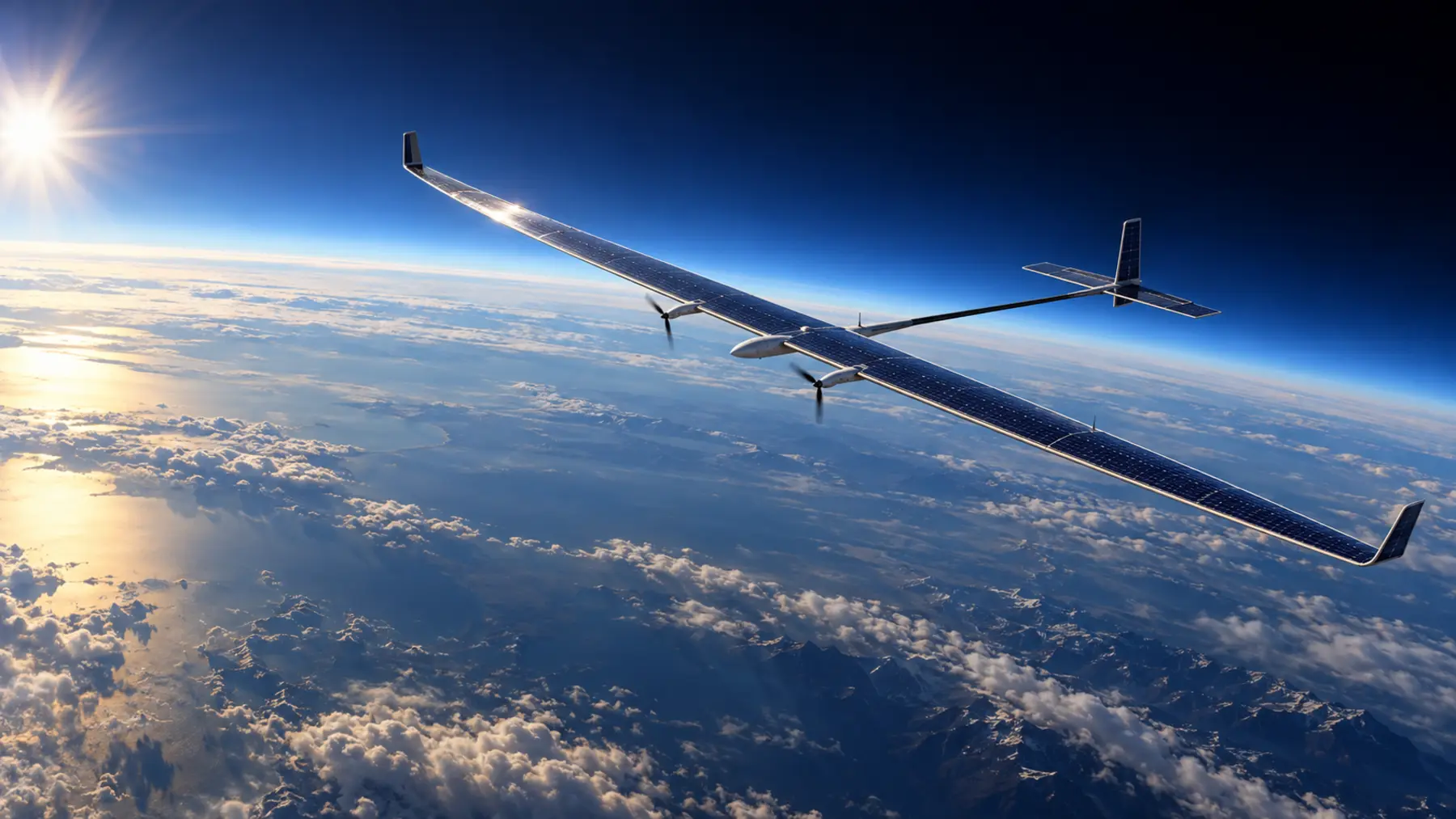
Zephyr is a high-altitude platform station: an uncrewed aircraft intended to carry communications or observation equipment. Airbus describes the programme as solar-electric; AALTO says the design combines carbon-fibre structure, solar cells and lightweight batteries. At roughly 25 metres across and under 75 kilograms, its remarkable size-to-mass ratio helps it fly where the air is extremely thin. Airbus on solar flight.
What the solar system is doing up there
Sunlight strikes photovoltaic cells on the wing and is converted into electricity. Power can run the aircraft’s electric motors and onboard equipment; surplus is stored in rechargeable batteries for periods with little or no sunlight. A technical paper on solar-electric aircraft describes the same chain: solar array, power electronics, motor and propeller, with excess energy stored for night flight.
The plane still faces night, weather, changing seasons and a limited energy budget. Its achievement comes from balancing all of them: collecting enough energy, keeping the structure light and limiting the power needed to stay aloft. A solar array alone cannot solve the problem.
Solar cells designed for watts per kilogram
A technical conference paper identifies Zephyr 8/S as using tandem photovoltaic cells from MicroLink Devices. MicroLink’s own UAV-cell specifications describe gallium-arsenide-based single-, dual- and triple-junction cells, with demonstrated cell efficiency of up to 31% under standard AM1.5 illumination. The cells are less than 40 micrometres thick and are made to be light and flexible. Technical paper on solar-electric aircraft · MicroLink photovoltaic specifications.
That 31% figure is a cell-level result under a defined test spectrum. It is not an annual yield figure, a guarantee for every aircraft surface, or a promise that domestic solar panels will generate 31% more electricity. A stratospheric aircraft is optimised for power per kilogram and low weight. A home system is judged by its expected kilowatt-hours across the year, the roof available, cost, shading, and how the household can use or store the electricity.
The battery turns daytime generation into night flight
AALTO says the aircraft’s secondary batteries recharge from solar energy during the day and then power both the aircraft and payload at night. That is the part homeowners will recognise: generation and consumption rarely happen at exactly the same time, and storage can move some electricity to when it is needed. Our guide to what a home battery can do with daytime generation.
But there is an important difference. A home battery does not automatically provide emergency power when the grid fails. Energy Saving Trust notes that additional equipment and configuration are normally needed. If backup matters, it must be designed into the home system, with safe isolation from the grid. Why solar panels and a battery may not power your home in a power cut.
Scotland’s solar-flight connection starts near Oban
Zephyr itself is not a Scottish aircraft. But Scotland has hosted its own solar aviation work. In 2025, Limosaero tested a solar-powered drone in airspace near Oban with support from the Scottish Association for Marine Science (SAMS) and Oban Airport. It is a much smaller, lower-flying aircraft—under 18 kilograms, designed for flights of up to 12 hours and operations below 10,000 feet. The trials carried scientific instruments, including a turbulence probe for studying wind energy around floating offshore wind farms. SAMS report from Oban.
That is not a local Zephyr test, and the two aircraft serve different purposes. But it shows how solar-powered flight can support Scottish work on marine science, weather and renewable energy, as well as high-altitude communications.
Glasgow researchers are working on the photovoltaic receiver
The most striking Scottish connection is a new project called LIVINGSTON—short for “laser diodes and photovoltaics for enduring atmospheric platform power beaming.” The University of Glasgow is developing a photovoltaic receiver intended to convert a beam of laser light back into electricity on an aircraft. Durham University is developing the ground-station optics and tracking, while Scalable Laser is developing the laser system. The proposed link is up to 25 kilometres. This is research and development, not a system already powering an operational aircraft. Durham’s project announcement.
Professor Stephen Sweeney and Dr Adam McKenzie are worth naming: the University of Glasgow’s James Watt School of Engineering identifies them as leading Glasgow’s contribution. Sweeney is a Professor of Photonics and Nanotechnology with a research background that includes laser power converters; McKenzie is a Royal Commission for the Exhibition of 1851 Research Fellow in Electronic and Nanoscale Engineering, specialising in semiconductor materials. James Watt School update on LIVINGSTON · Professor Sweeney’s profile · Dr McKenzie’s profile.
This project stretches the solar story in an unexpected direction. The aircraft would not be collecting sunlight for this part of its power: electricity on the ground would be converted to laser light, transmitted through the atmosphere, then converted back to electricity by photovoltaic cells on the aircraft. PV remains central, but the source of the light is different. The goal is to ease the energy and endurance limits that make long-duration stratospheric flight so difficult.
LIVINGSTON is one of 18 teams in ARIA’s £70 million Enduring Atmospheric Platforms programme. ARIA’s stated ambition is to demonstrate an aircraft operating above the UK for a week while continuously powering a communications payload. That is a programme goal, not a result already achieved. ARIA programme overview.
What this means for a Scottish home
No homeowner needs aerospace-grade solar cells to make rooftop solar worthwhile. The useful comparison is the engineering approach: understand the energy source, match equipment to the job, and plan how electricity is used over time. On a home, that means assessing the roof, estimating generation through the seasons, understanding daytime and evening demand, and deciding whether battery storage or backup power belongs in the design.
The Zephyr also gives us a vivid reminder that solar is not simply “panels on, problem solved.” Sunlight varies. Batteries have limits. Loads matter. And a battery intended to shift energy for everyday use is not automatically a backup system for a power cut.
Thinking about solar and battery storage in Scotland?
Start with the roof and the household’s actual energy use. A well-designed system should explain what it is expected to generate, when the home can use it, what a battery changes—and exactly what happens if the grid goes down.
Check My Roof FreeSources and further reading
- AALTO: solar-powered flight and endurance records
- Airbus: Zephyr 2021 test-flight campaign details
- International Council of the Aeronautical Sciences: design considerations for solar-electric high-altitude aircraft
- MicroLink Devices: photovoltaic technology and cell specifications
- SAMS: solar drone tests near Oban
- Durham University: LIVINGSTON laser power project
- ARIA: Enduring Atmospheric Platforms programme